Game · In development · October 2026
Nyout
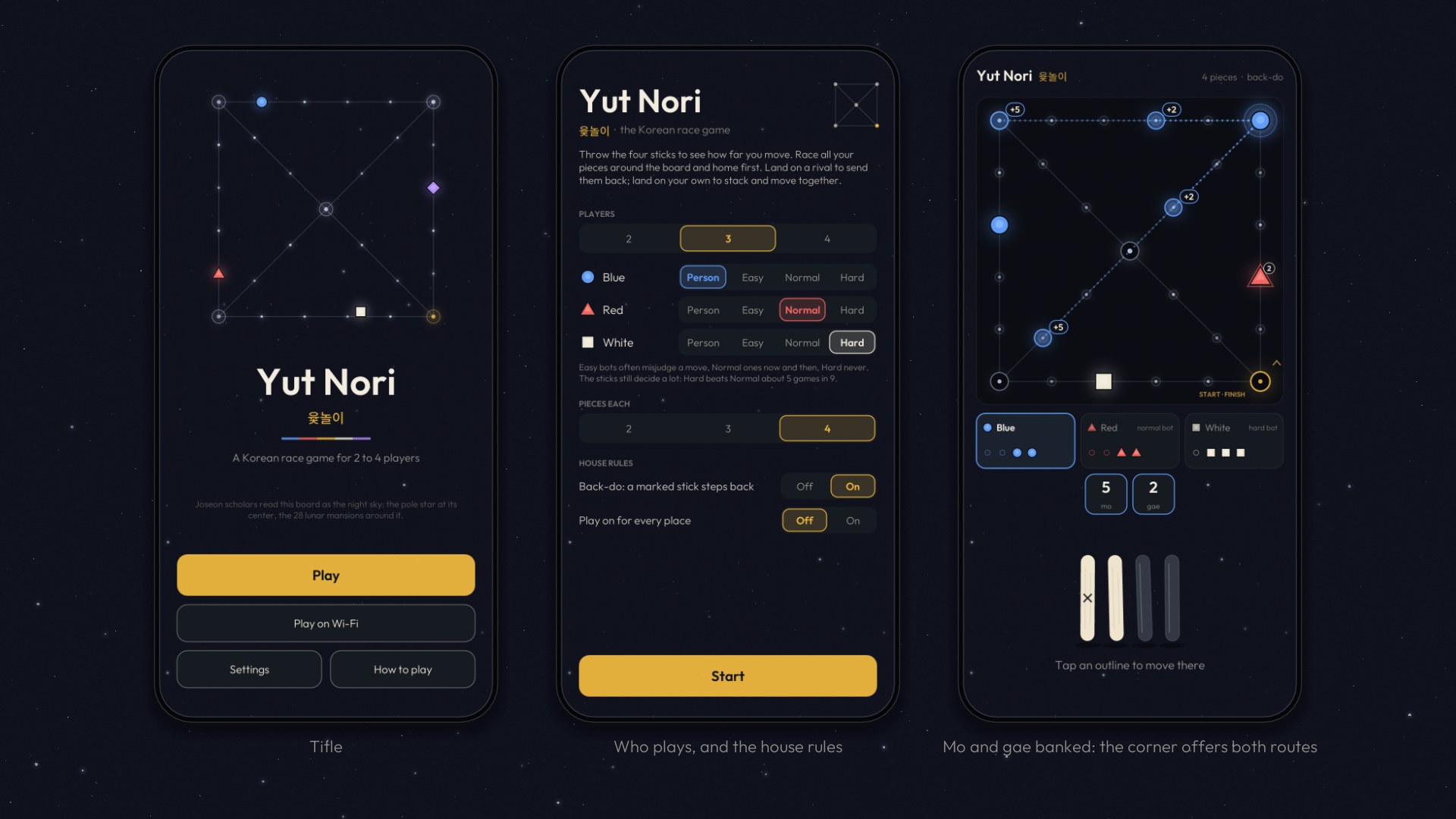
Yut nori, the Korean race game, for Android. The board is drawn as the star chart Joseon scholars saw in it. Play on one phone with friends or bots, or across phones on the same Wi-Fi.
Clips
Flick the sticks
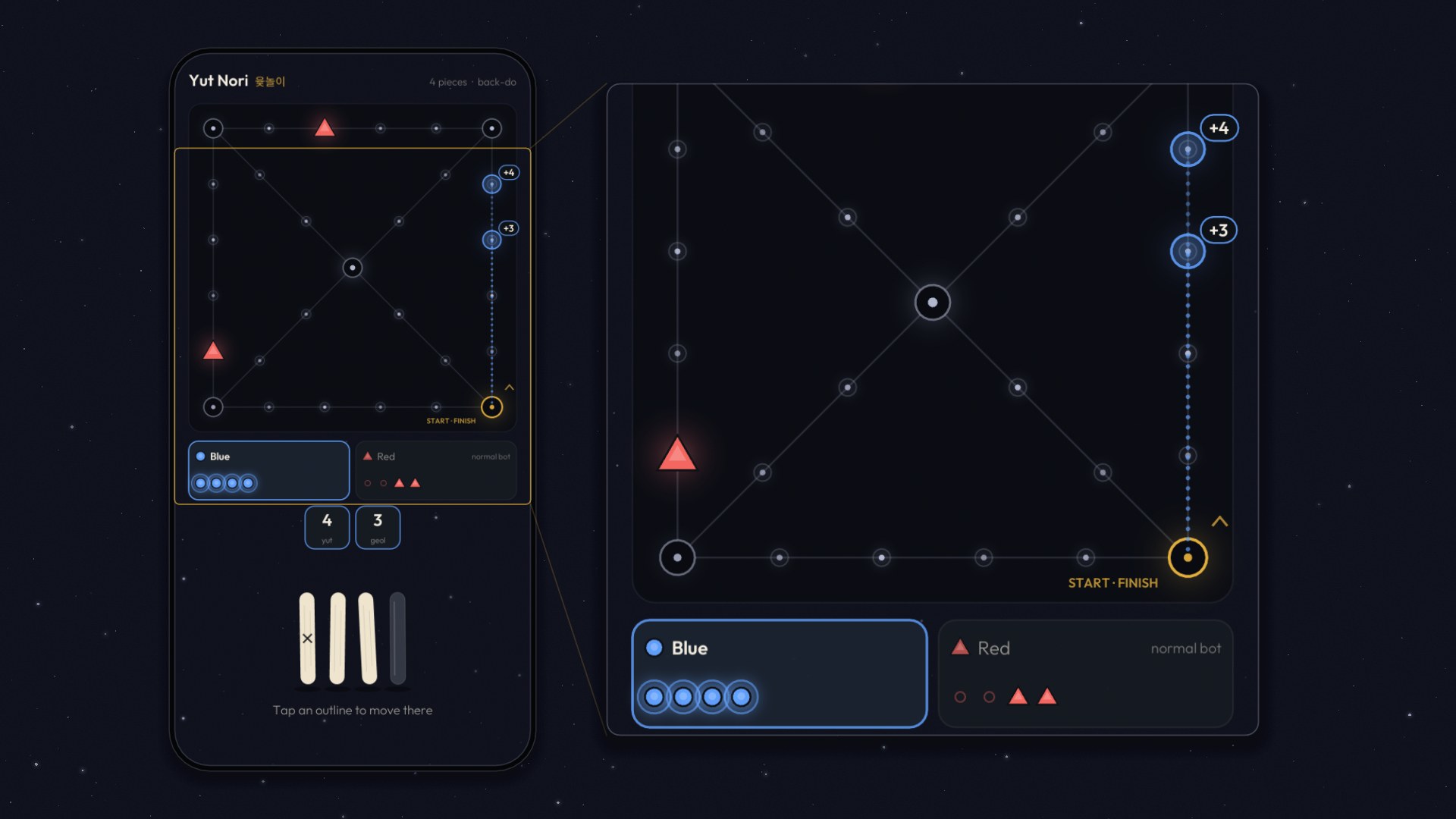
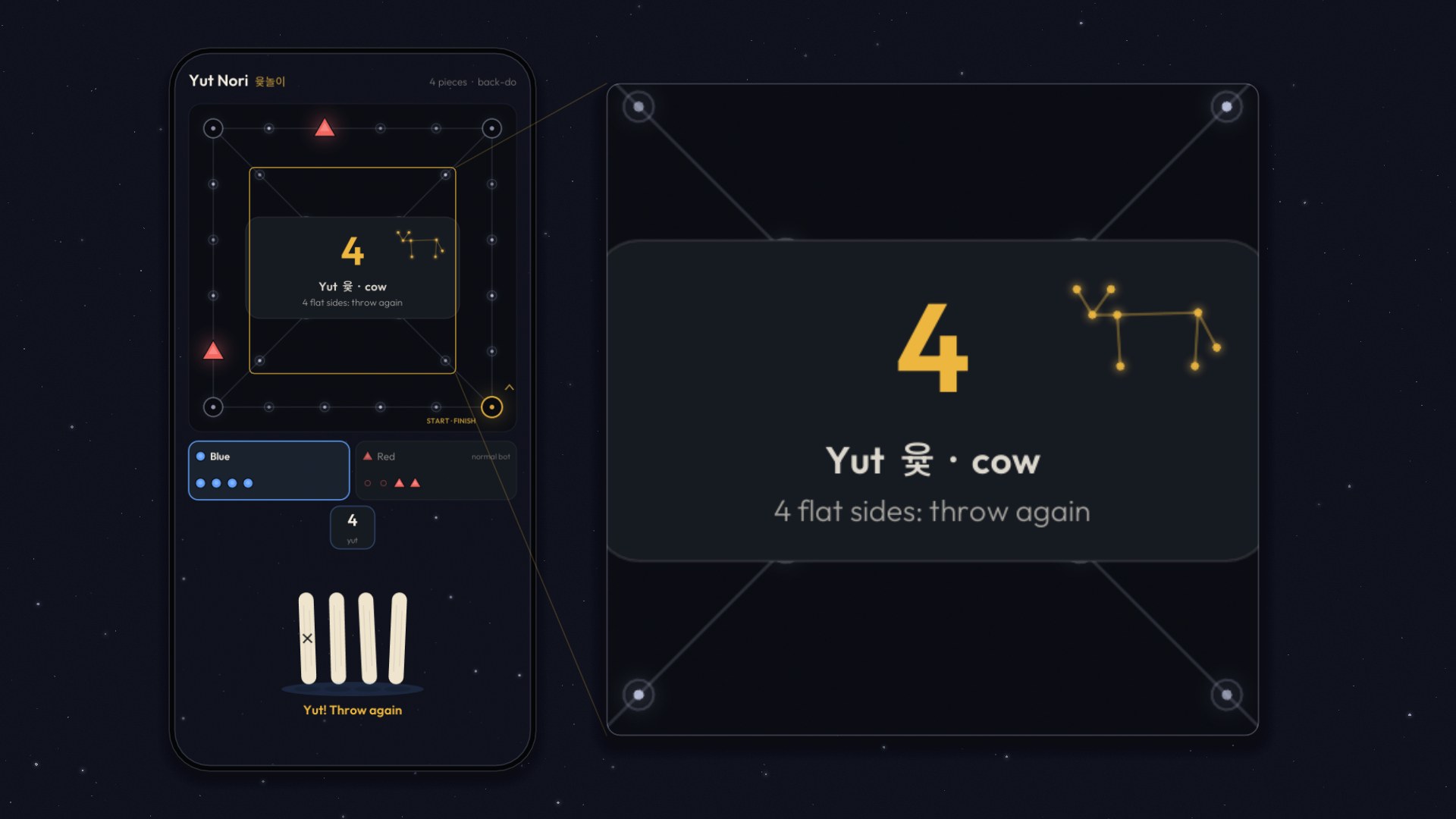
Touch the tray and the four sticks gather into your hand. Flick up and they fly, higher for a faster flick. Each flat side up is a step. Four flat sides is yut, worth 4 and another throw, and the readout shows its animal, the cow, as a constellation. Both throws wait in the bank under the board, and tapping your card offers a ghost for each.
Sent home
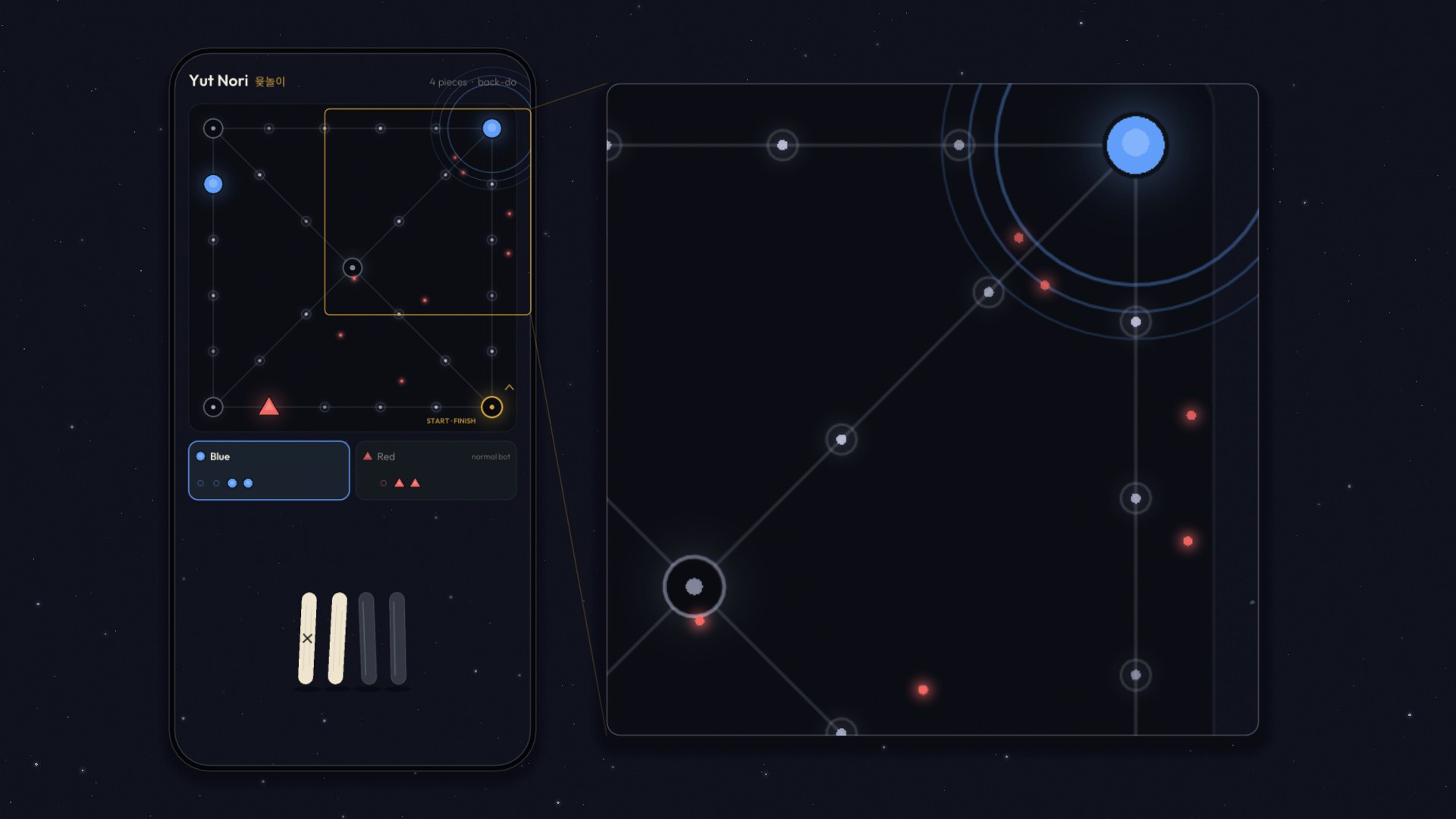
Blue throws a 2, and the outline on Red's corner glows gold because it's a capture. Landing there sends a shockwave through the picture, and Red's piece dissolves into motes that stream back to its card. A capture earns another throw.
Home, and a star
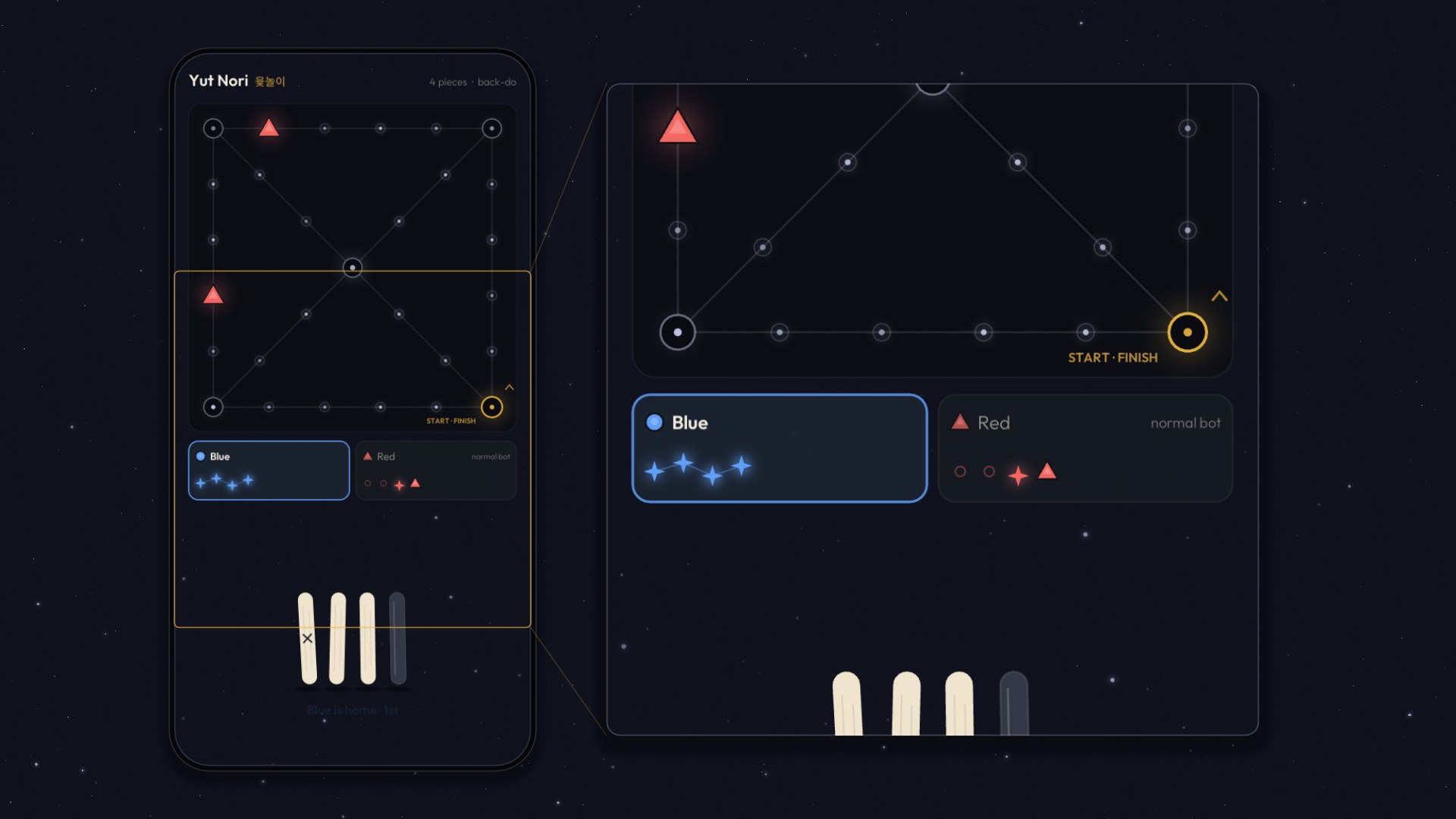
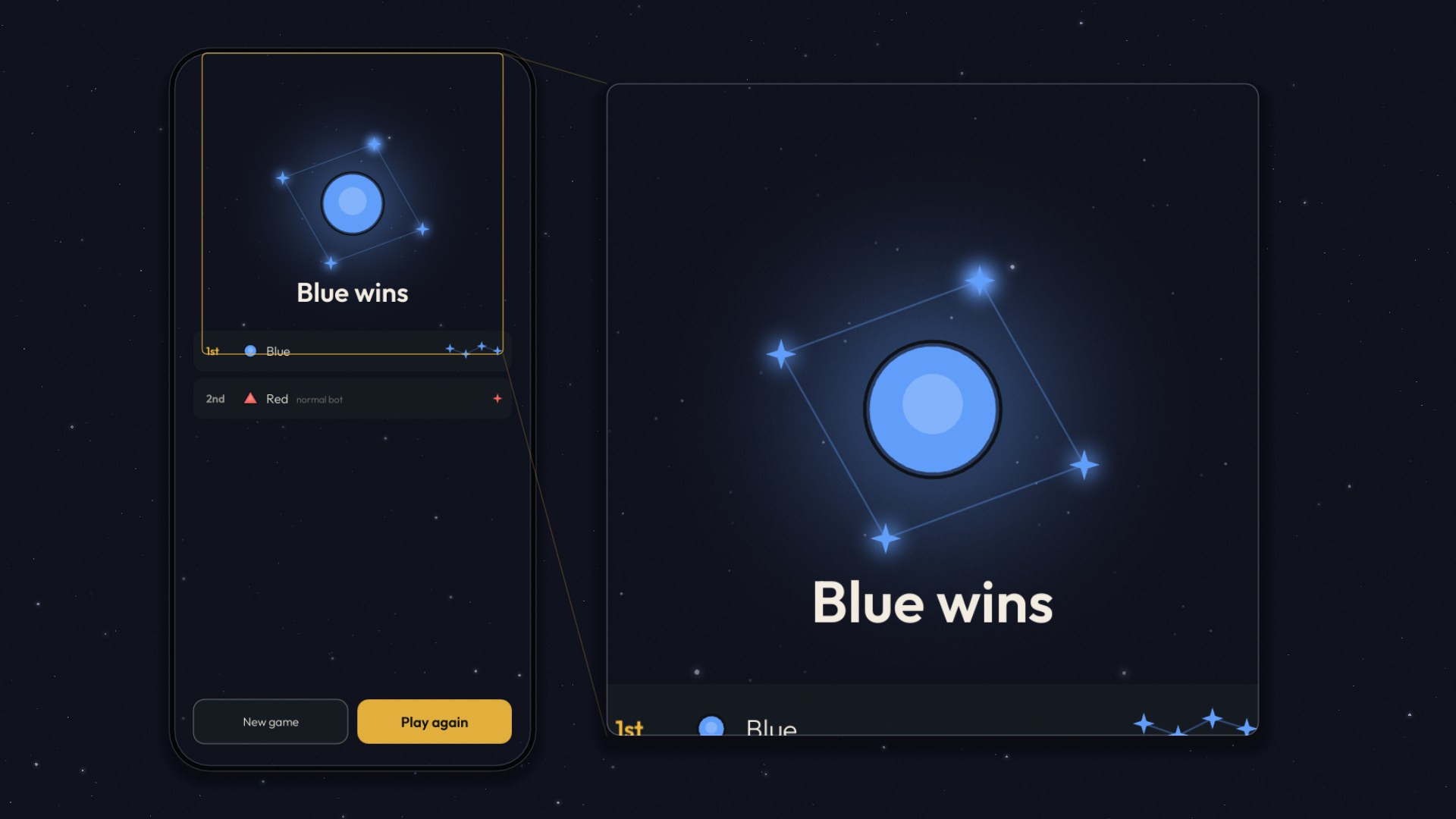
Blue's last piece passes the start corner and lifts off the board. It lands on Blue's card as a star, and the four stars join into a constellation. Every player leaves the game as one, sized by the pieces they brought home.
Same Wi-Fi
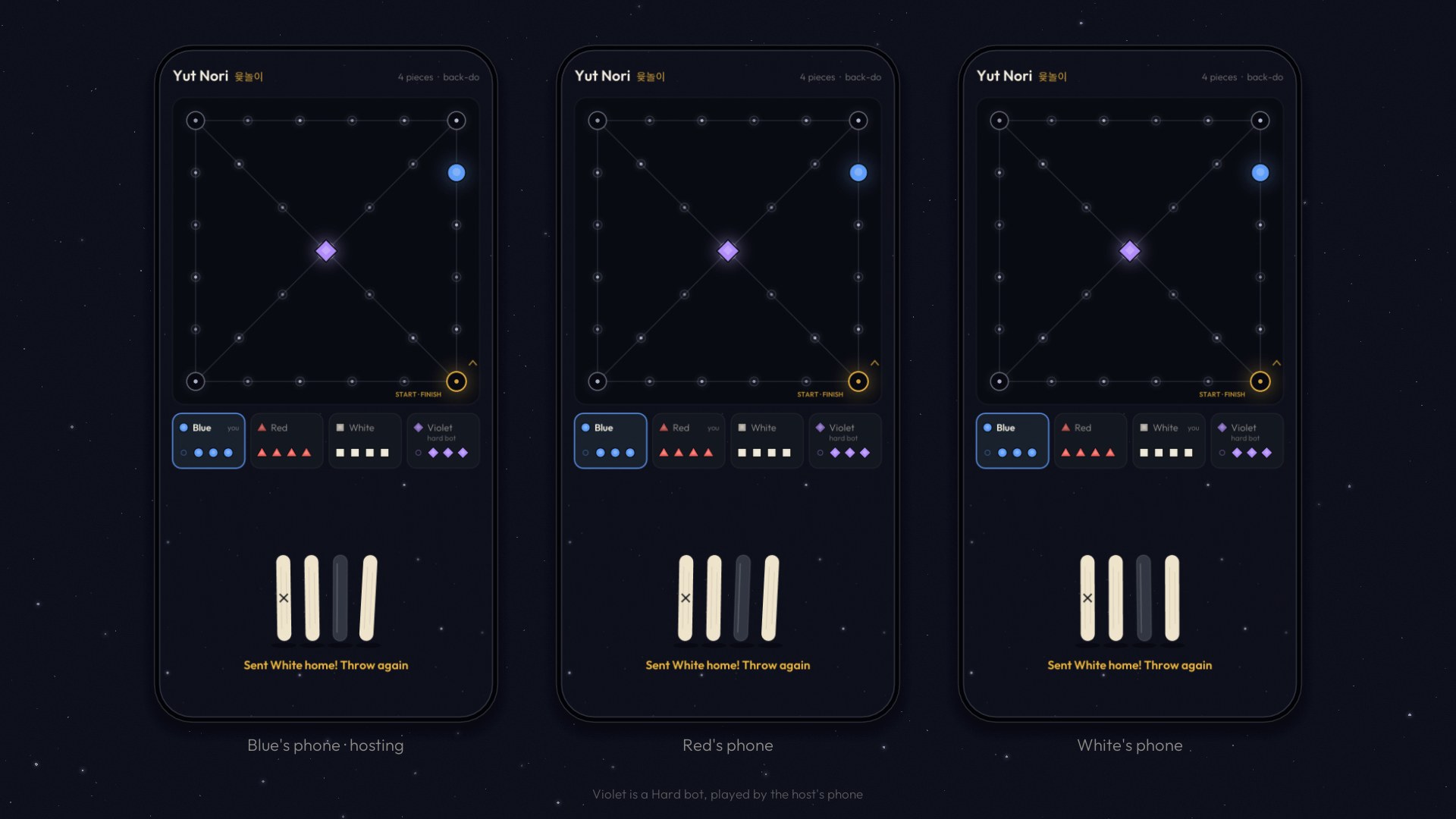
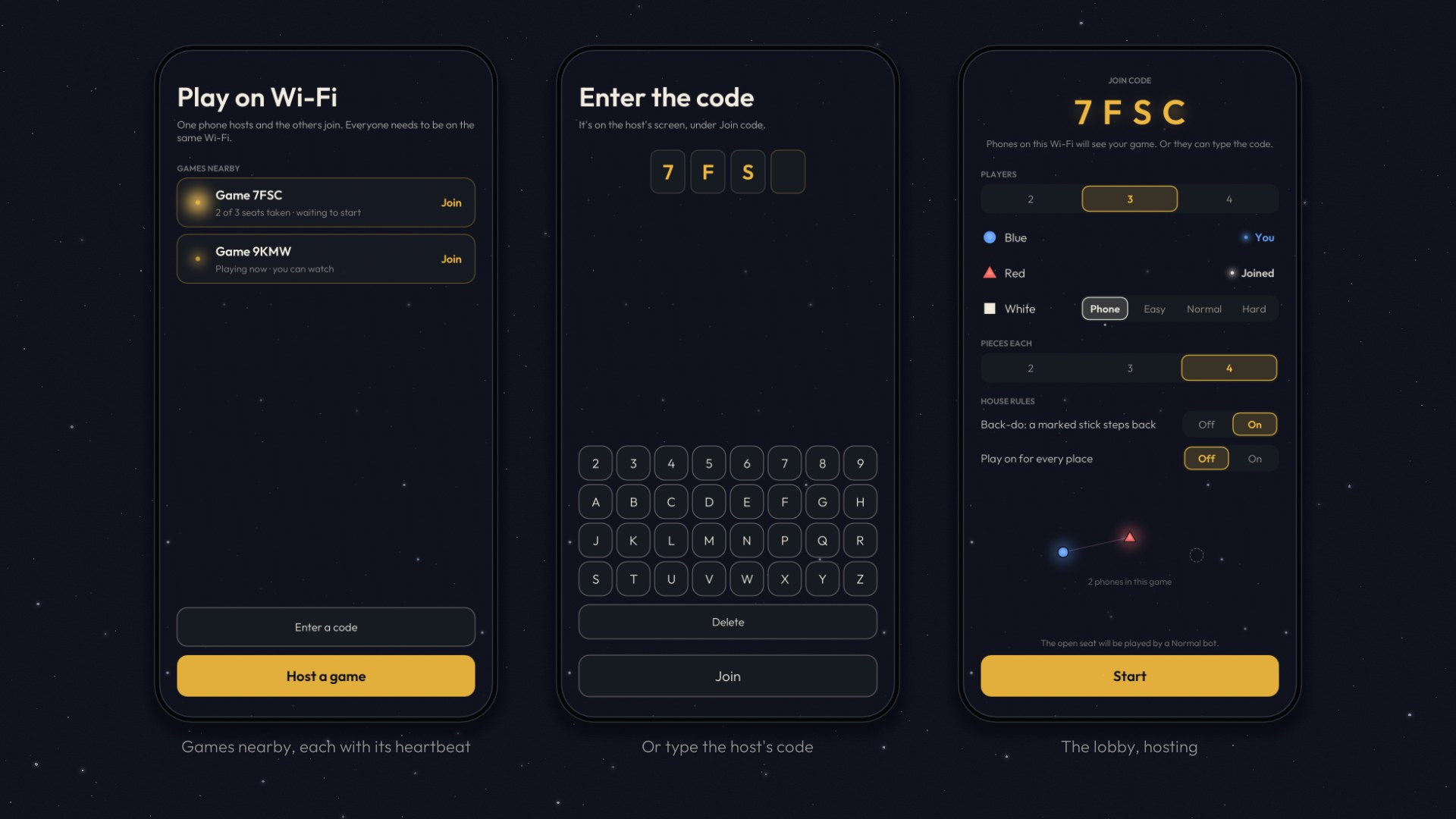
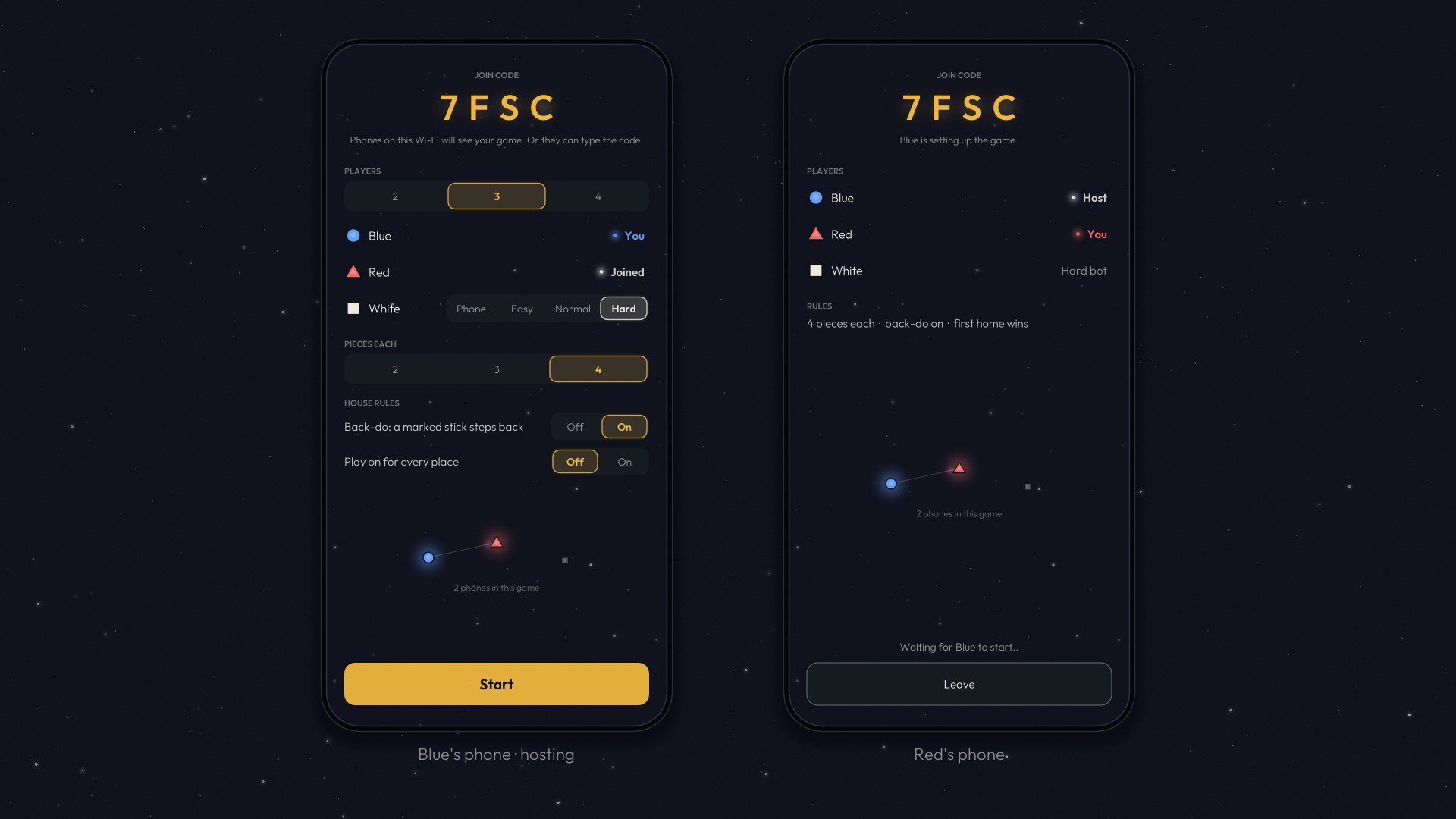
One phone hosts and the other finds it. Each game nearby pulses with its host's beacon. Red joins, and the lobby draws the two phones as stars joined by a thread of light. The host adds a third seat for a Hard bot, which shows up on Red's phone right away, then starts. The first throw lands on both screens.
Screenshots
About
Yut nori is the game Korean families play at the new year. You throw four sticks instead of dice, then race your pieces around a square board with two diagonals. Corners offer shortcuts through the middle. Landing on a rival sends them home, and landing on your own piece stacks them so they move together. Nyout is a version of it for Android phones, built from scratch in LÖVE. It replaces a small Unity prototype from 2025 that had only local play.
You can pass one phone around, play against bots at three levels, or play across phones on the same Wi-Fi. Online play with room codes is next.
The cover is one whole game as a long exposure. Every hop of every piece is traced over the board like a star trail, one colored thread per player. Each piece that came home rises from the finish corner and becomes a star in its player’s constellation.
The Board Is a Sky
Joseon-era scholars read the yut board as a map of the heavens: the pole star at its center, the 28 lunar mansions around it. Nyout takes that as its one idea.
- Every screen sits in a deep indigo sky, and the board is drawn as a star chart. Each station is a small star, and the corners and center are ringed as landmarks. The only colored spot is the shared start and finish, in gold.
- Pieces give off a little light in their own color. A finished piece flies off the board and becomes a star on its player’s card.
- The five throws have animals (pig, dog, sheep, cow and horse). Each appears as a tiny constellation beside the step count.
- There is no full-screen bloom. Glow is an additive sprite drawn only where light means something, and the capture shockwave is the one shader pass, running only while a wave expands.
Numbers First
The first time I played it by hand, the screen led with 도, 개 and 걸. Anyone who doesn’t read Korean had to learn a vocabulary before learning the game. Now every throw leads with what it does: a big step count, then the name and the reason underneath (“Geol 걸 · 3 flat sides”). Banners say why things happen: “Sent Red home! Throw again”, or “No piece can move −1, so it’s skipped”. Korean stays as an accent.
Bots That Count in Throws
The AI prices everything in one unit: expected throws to bring a piece home. That one number is solved for every position on the board under each rule set.
- It weighs progress, captures, stacks and shortcuts in that unit.
- It counts the exact chance that a rival lands on each of its pieces next turn.
- Each decision searches every order of spending the banked throws.
Between bots that don’t blunder, the sticks decide most games. So the three levels differ by how often they misjudge, not by how deep they search. Over 1,000-game matches, Hard beats Normal 56% of the time, Normal beats Easy 65%, and Easy beats a random player 89%.
Same Wi-Fi
One phone hosts. Its game runs in a background thread, with an ENet server and a beacon calling out once a second. Other phones list the games they hear, each with its heartbeat. Some routers filter broadcasts, so every game also has a join code that spells the host’s address in four letters on a typical home network.
A phone that drops out keeps its seat. If it isn’t back within 30 seconds, a bot plays for it until it returns. A phone that restarts gets the same seat back. Same-Wi-Fi play is new and is being tested across phones now.
Learn by Playing
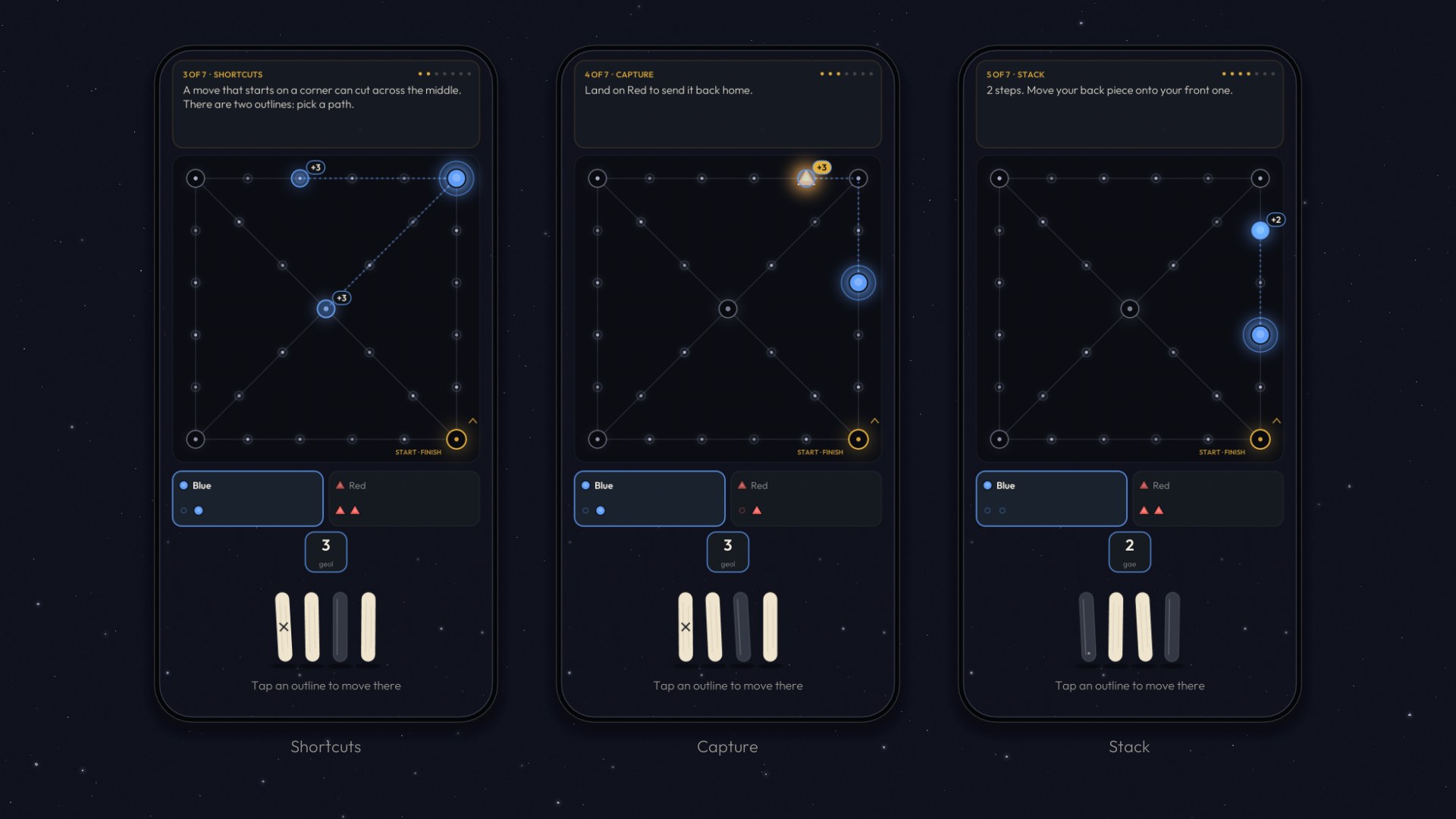
The how-to-play is the real game. Seven short lessons each stage a position and the throws that will come up, then ask for one thing: throw, throw again, take a shortcut, capture, stack, step back, come home. The rules, the input and the animation are the same ones a real game uses. If the turn ends without the goal, the lesson sets itself up again.
Sound
Every sound and the music are synthesized when the game starts, in a thread, with no audio files.
- Tuned sounds sit in G major pentatonic. Each station a piece hops plays the next note up, so a move sounds like a short phrase.
- Bells beat slowly between two close partials. That beating is maekno-ri, the sound Korean temple bells are known for.
- Each player has a turn note, so people passing a phone learn to hear whose turn it is.
- The music is a drone plus sparse plucks that loosely evoke the gayageum. Every frequency is snapped to whole cycles per loop, so it loops without a seam.
Under the Hood
- Rules: a pure Lua engine over explicit route tables, with no geometry. It never mutates state and returns events for the view to animate. A 10,000-game simulation checks the invariants after every step.
- One authority: a single Room runs every mode. It is in-process for local play and in a thread on a Wi-Fi host, and it will run on a server for online play. Clients only send intents. Even local play sends real protocol bytes.
- Layout works in real units from the phone’s safe area, so it fills screens of any shape without letterboxing.
These stills and videos were rendered by the game itself. Each phone is a real game view drawn offscreen at twice phone resolution on a locked clock, with simulated taps. The three phones in the loop are three clients of one Room.
Technical Details
- Language: Lua (LuaJIT)
- Framework: LÖVE 11.5 with LoveLibs, packaged for Android with love-android
- Networking: ENet over UDP, luasocket broadcast discovery, JSON protocol
- AI: Expected-throws evaluation from value iteration over the route tables, exhaustive search of throw orders, and exact exposure
- Audio: Procedural synthesis in a worker thread
- Fonts: Outfit and a hand-subset Noto Sans KR