Instrument · Released · October 2026
Chromatic Tuner
A calm Android tuner that hears a string to within a cent. An arc meter eases from amber to sage as you turn the peg, and the note blooms softly when the string comes true.
Screenshots
About
Chromatic Tuner is a guitar and ukulele tuner for Android. Hold your phone near the instrument, pluck a string, and it shows the note and how far off it is, in cents. It listens only while it is on screen. There is no start button and nothing to configure before you begin.
The first version worked, but it never felt right. The needle jumped, low strings read an octave off, and the ukulele’s A string could not be read at all. This version rebuilds it from the microphone up: a better way of hearing pitch, a steadier reading, and a quieter design that gets out of the way of the instrument.
The cover is a multiple exposure. One note glides into tune, and the meter is caught at a series of moments as it comes in, from amber far out on the flat side to sage at the center. The final frame is the moment it locks: the arc brightens and a soft halo blooms behind the letter.
What You See
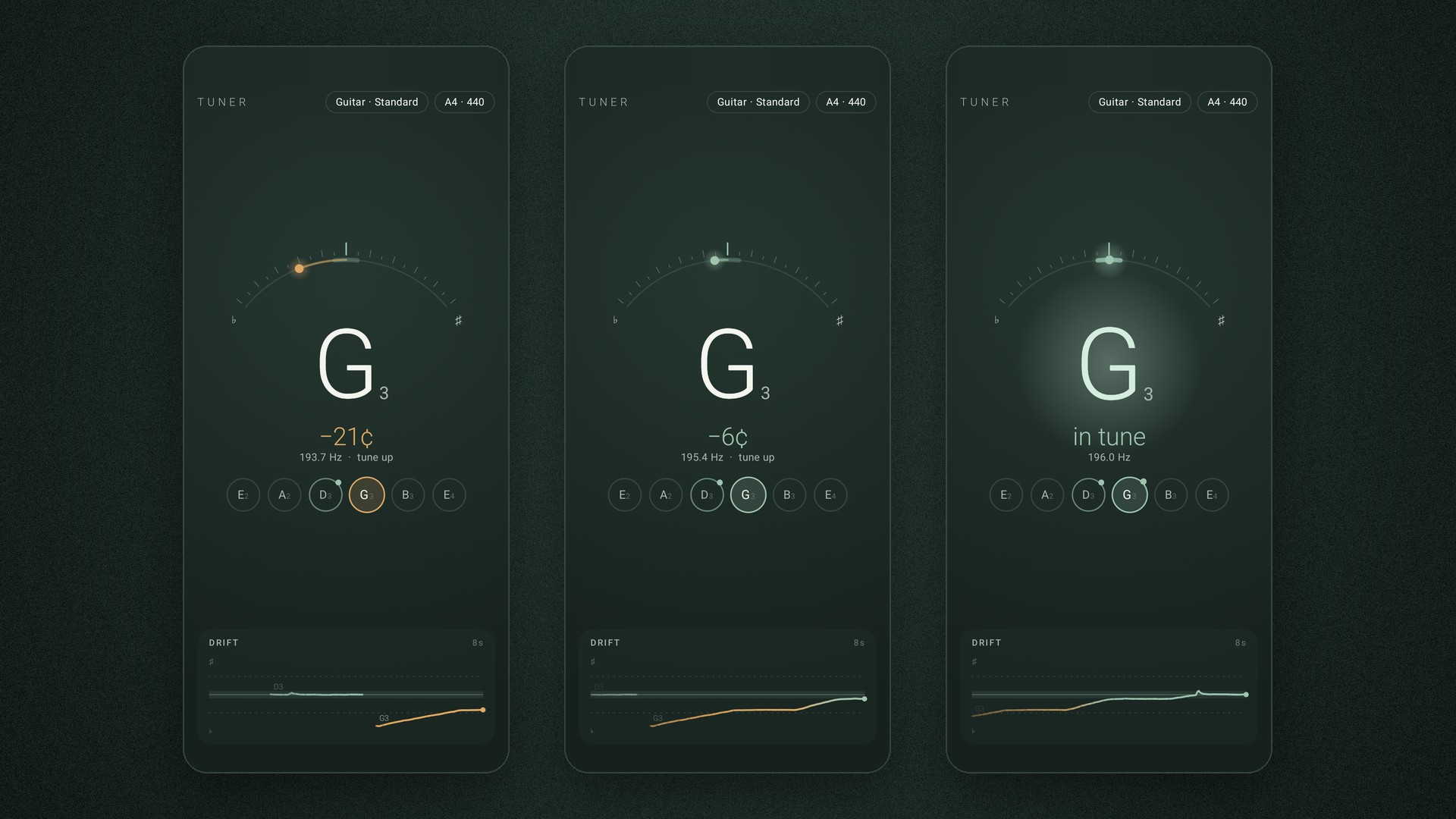
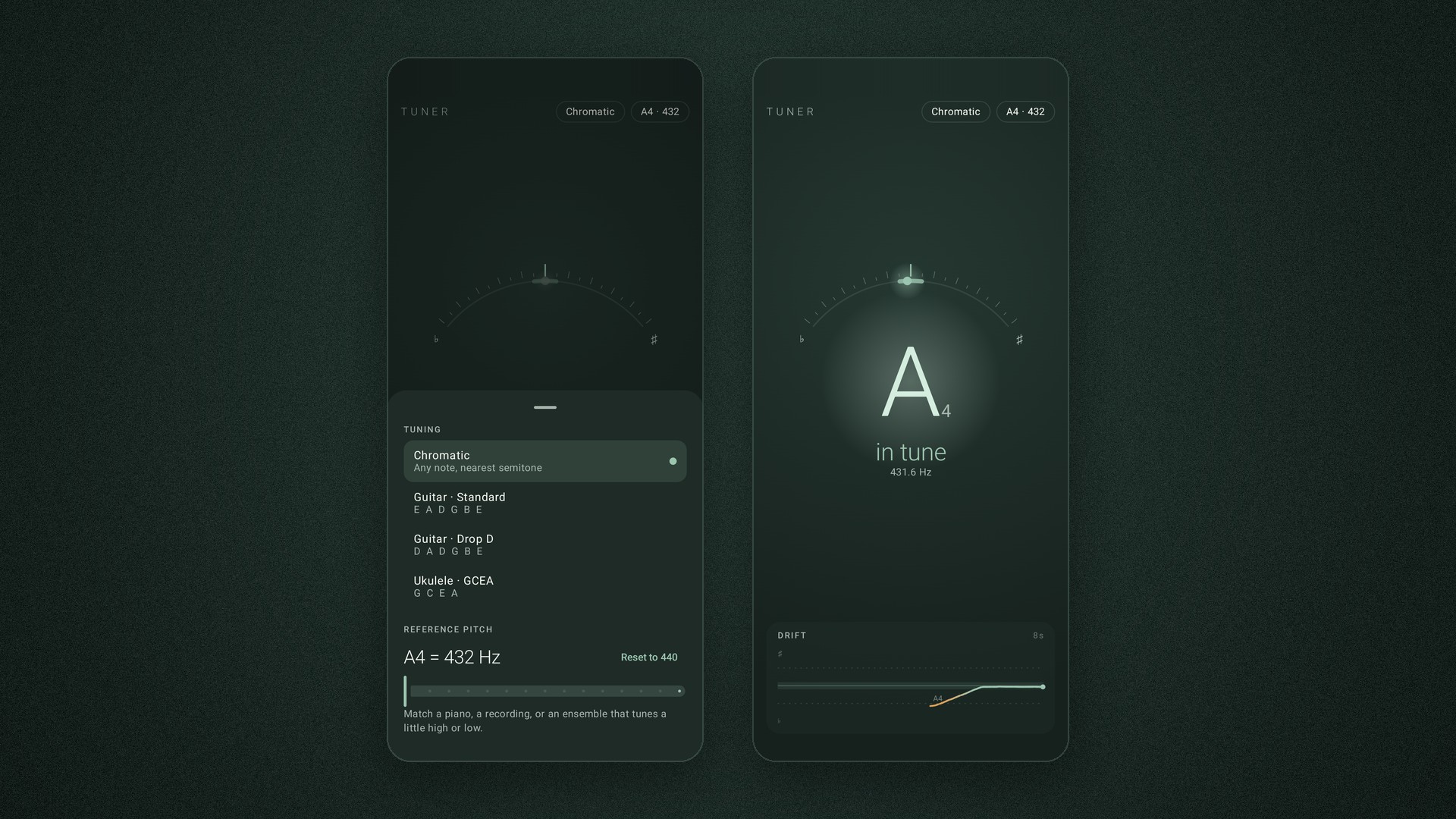
- The arc spans 50 cents flat to 50 cents sharp. A small glowing pip travels along it on a spring, so the reading glides instead of jumping. Its color eases from amber to sage as you get closer.
- The note sits large beneath the arc, like the letters under the arc of the logo. A small octave number sits beside it.
- The readout gives the offset in cents, the frequency, and which way to turn the peg: tune up or tune down.
- In tune. When a note holds within 4 cents for a little under half a second, it locks: the letter turns pale sage, a halo blooms behind it, and the phone gives one soft tick.
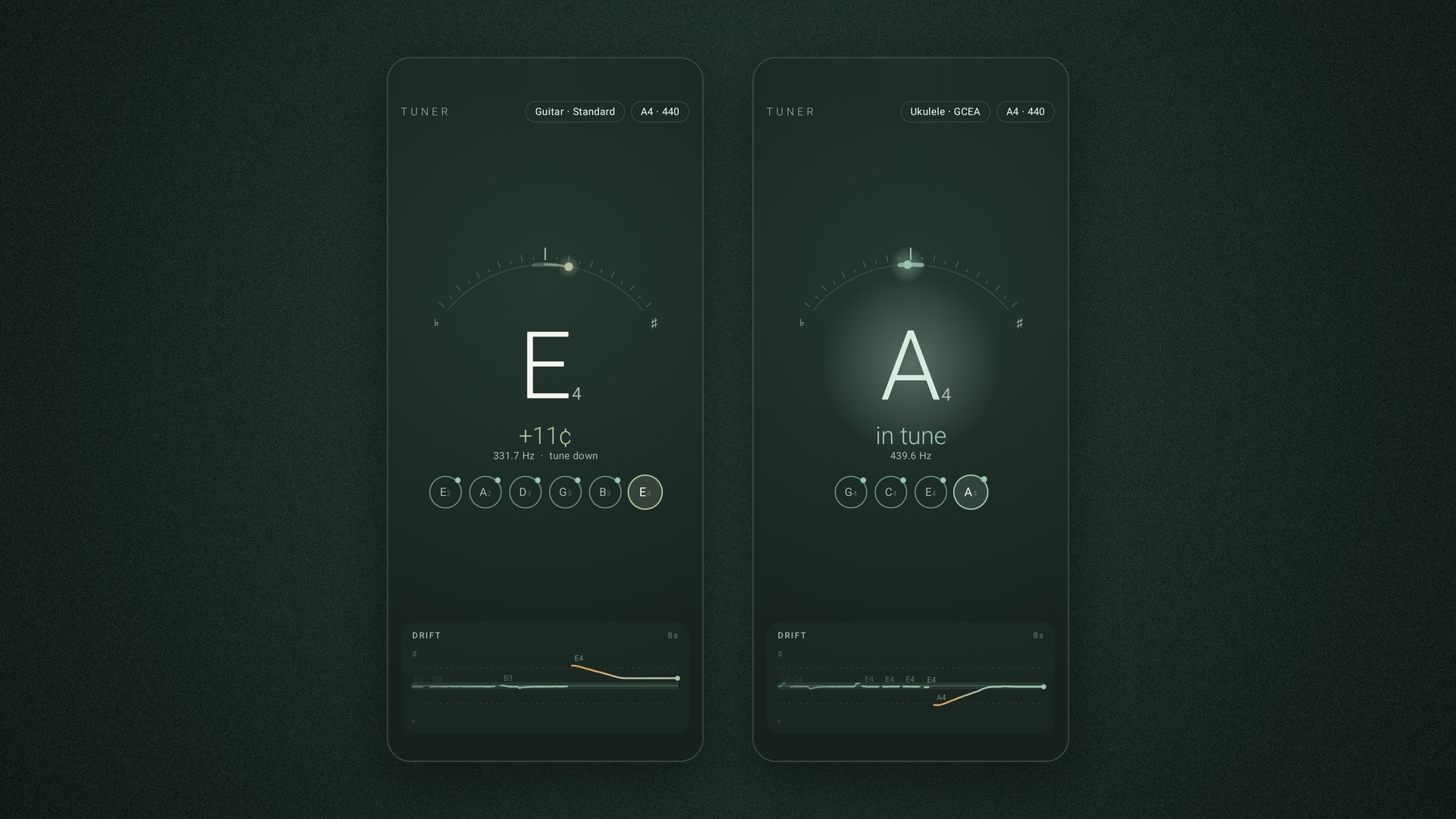
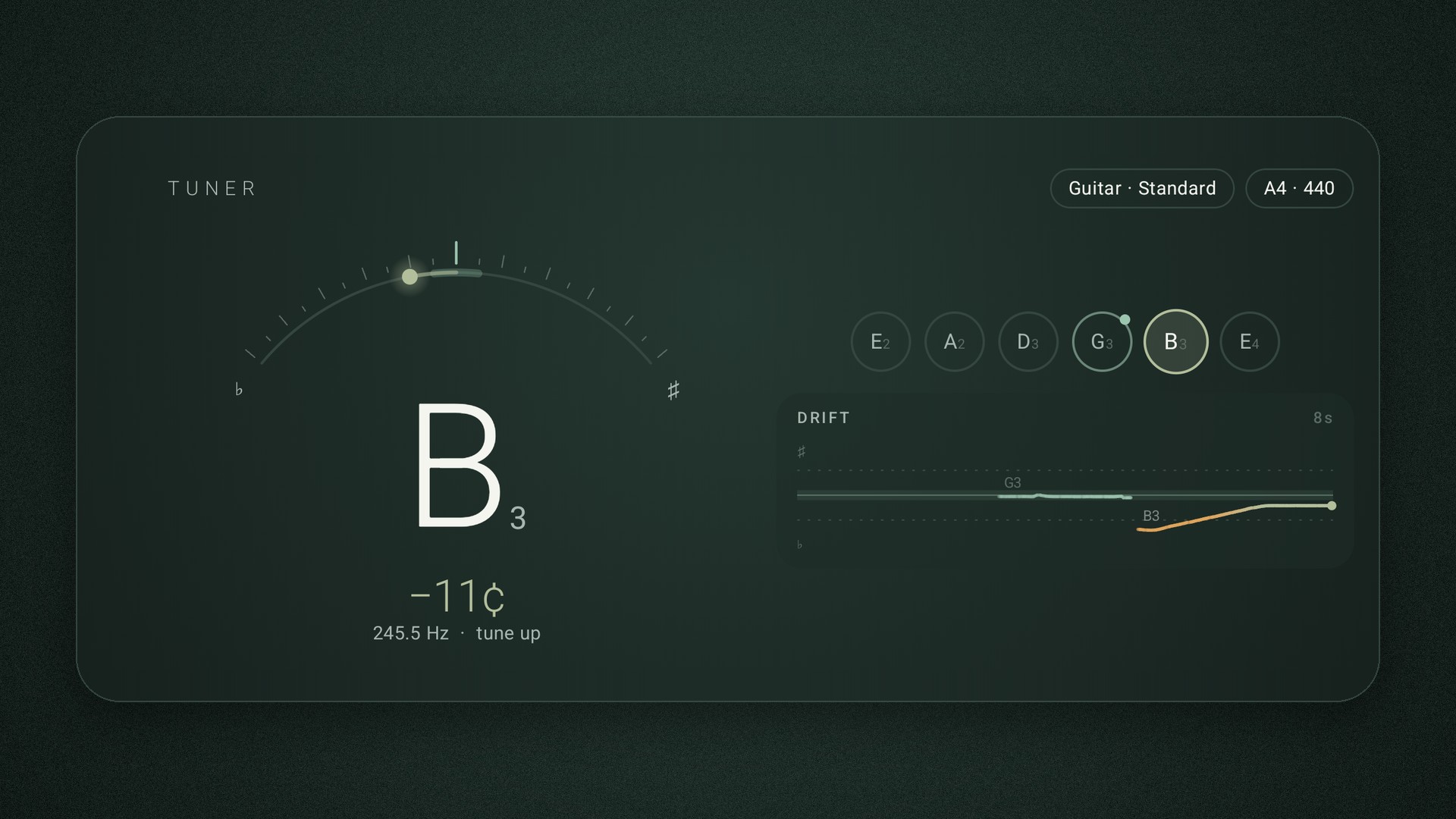
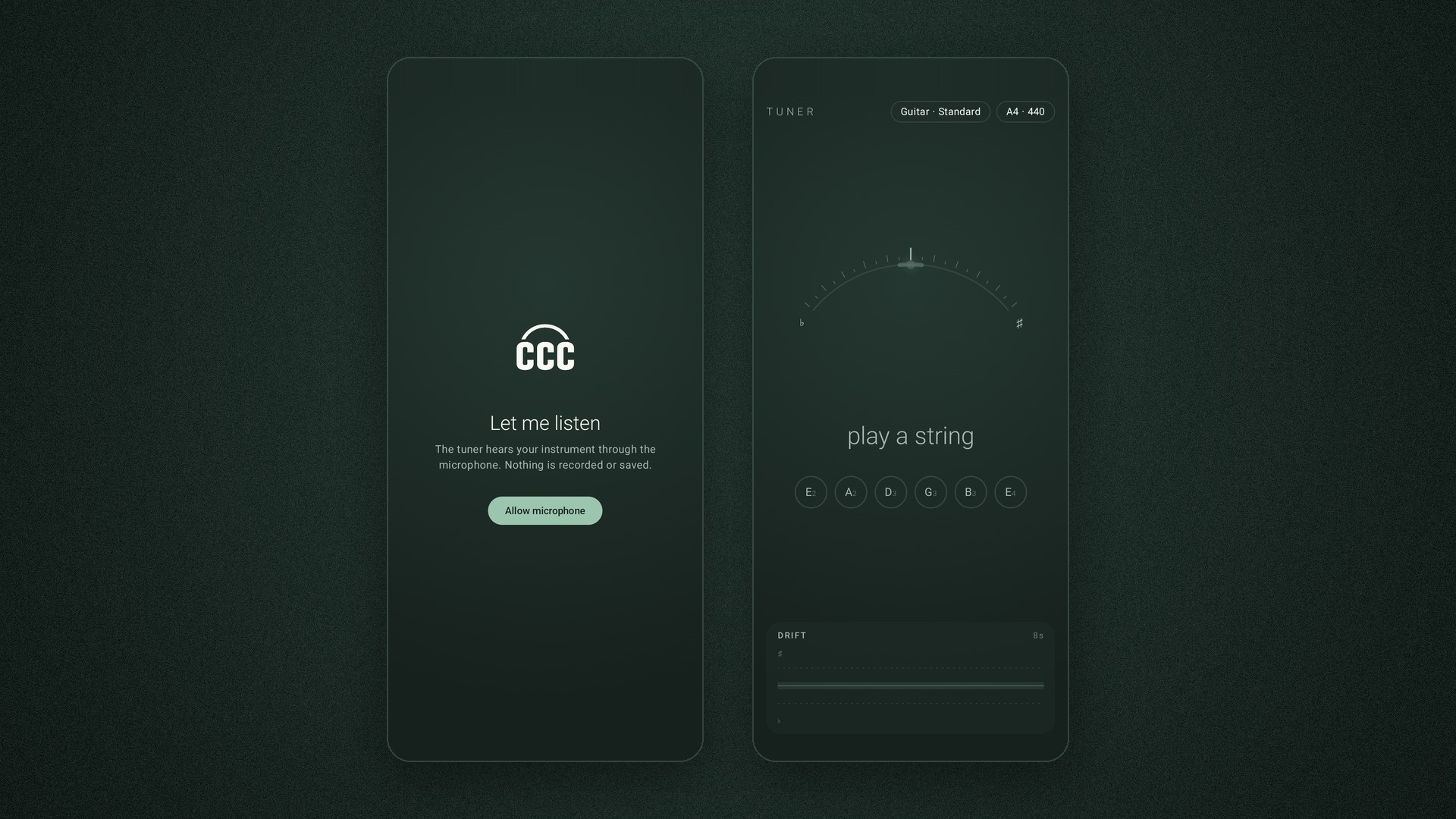
- The strings. Choose a guitar or ukulele tuning and a row of strings appears. The one you are playing lights up. Each string you bring into tune keeps a small sage dot, so the whole instrument fills in as you go.
- The drift trace shows the last eight seconds as a line drifting in toward the center. The center is in tune. Older readings fade like a comet’s tail, and each new note is labeled where it starts.
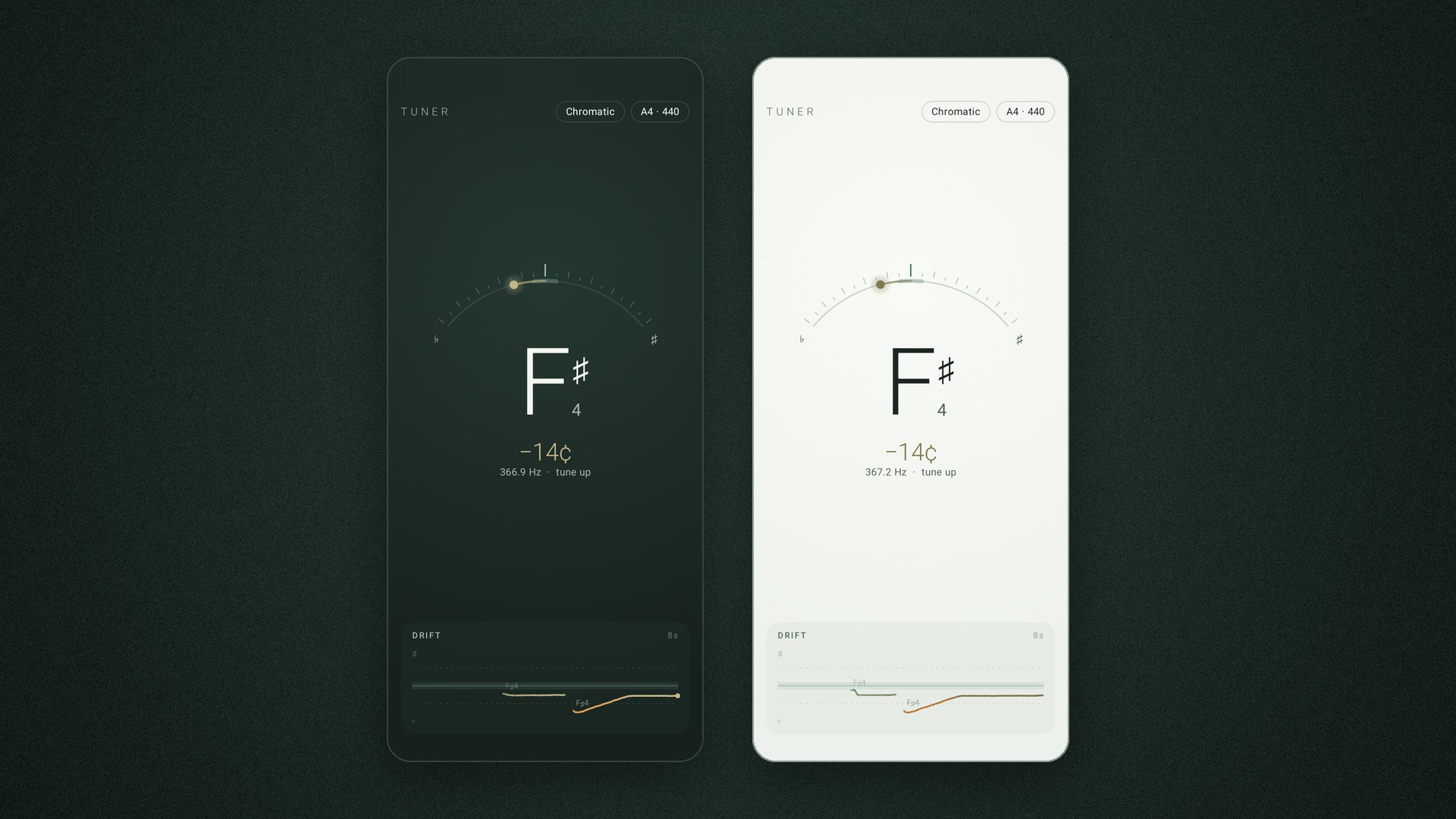
Drift is amber on both sides of center. Flat and sharp are told apart by position and the ♭ and ♯ marks, never by red and green, so the meter reads the same for colorblind players.
Tunings
- Chromatic — any note, to the nearest semitone
- Guitar · Standard — E A D G B E
- Guitar · Drop D — D A D G B E
- Ukulele · GCEA — re-entrant G
In a string tuning, the tuner targets the nearest string, not the nearest note. A low E tuned a whole step down still reads as the E string, 200 cents flat, so you know which peg to turn. The reference pitch can be set anywhere from A4 = 432 Hz to 446 Hz, to match a piano, a recording, or an ensemble that tunes a little high or low. Both choices are remembered.
How It Listens
The old version looked for the loudest peak in a frequency spectrum. At its resolution, each step of the spectrum was 5.4 Hz wide, but a semitone at low E is only 4.9 Hz. The low strings were guesswork, and the rules added to fix octave errors made them worse.
This version uses the McLeod Pitch Method, which measures how long the wave takes to repeat instead of which frequencies are loudest:
- The microphone is read at 48 kHz with no automatic gain or noise suppression, in a window of 4096 samples that moves forward 1024 samples at a time. That gives about 47 readings a second.
- Each window has its DC offset removed and passes through a gentle 2 kHz low-pass, so hiss can’t blur the result.
- An FFT computes the autocorrelation, and from it the normalized square difference function: a curve that peaks wherever the wave lines up with a delayed copy of itself.
- The tuner takes the first peak that reaches 90% of the tallest. Taking the first tall peak, not the tallest, is what keeps it from jumping an octave down.
- A parabola through the peak and its neighbors gives the period to a fraction of a sample, and so the pitch to about a cent.
Each reading also has a clarity, the height of that peak. A clear pluck scores near 1, and noise scores low.
Making It Steady
Raw readings flicker. A small pipeline turns them into a reading you can trust:
- A note only appears after a few readings agree, so the thump of a pick or a tap on the phone doesn’t flash up as a note.
- A median of the last five readings removes single-frame octave slips.
- A murky reading that also disagrees with the running pitch is treated as a dropout. A real turn of the peg stays clear and is followed.
- A click or a bump can make a few readings in a row jump exactly an octave. Such a jump is held back unless it outlasts what any single click could cause, about a tenth of a second.
- The tuner stays on its current note until the pitch has clearly moved, so it doesn’t flicker between two notes near the boundary. While it decides, the last reading holds.
- A 1€ filter smooths the cents. It holds a sustained note still but follows a turning peg without lag.
- When the string fades, its reading lingers, dimmed, for a moment and then lets go.
How These Were Made
Every image on this page is a real screenshot from a Pixel 8 Pro running the app. A short script synthesized plucked-string tones, played them from a speaker beside the phone, and captured the screen at chosen moments. A glide from 42 cents flat into tune produced the three frames in the first image. A sequence of in-tune plucks filled in the string dots. The images are cropped and set on a backdrop taken from the app’s own colors, with the status bar hidden. The cover layers nine captures of a single A4 easing into tune over the frame where it locks. Nothing in the app itself was drawn by hand.
The captures earned their keep. On-device logging during the shoot showed a brief transient reading as the octave below for exactly four frames, one analysis window. That led to the octave guard described above, which went into the app during the shoot.
Technical Details
- Language: Kotlin
- UI: Jetpack Compose and Material 3, with custom Canvas drawing for the arc and the trace, spring animations, dusk and paper themes, edge-to-edge, portrait and landscape
- Audio:
AudioRecordin float PCM from theUNPROCESSEDsource (orVOICE_RECOGNITION), exposed as a cold KotlinFlowthat opens and releases the microphone with its collector - Pitch: McLeod Pitch Method on an in-place radix-2 FFT, from 60 to 1400 Hz
- Architecture: MVVM. A pure, synchronous
TuningProcessorholds all the smoothing logic, a ViewModel wires capture to state, and DataStore stores the settings. - Tests: 36 unit tests on synthesized signals. Every open string is read to within ±1 cent, within ±3 cents with noise at 10 dB SNR, and a tone with its fundamental removed still reads at the right octave.
- Compatibility: Android 8.0+ (min SDK 26)